
Example increase in the numer of shares
Initial situation:
Company B
Starting value: 1,000
Starting capitalization: 141,500,000
Adjustment factor (AF): 1.00
Number of shares: 6,000,000
Price/share: 10.00 EUR
| Company | Number of shares | FFF | RF | Price | Index capitalization in EUR |
|---|---|---|---|---|---|
| SHARE A | 10.000.000 | 0.60 | 0.90 | 12.00 | 64,800,000 |
| SHARE B | 6.000.000 | 0.50 | 1.00 | 10.00 | 30,000,000 |
| SHARE C | 7.000.000 | 0.20 | 0.70 | 15.00 | 14,700,000 |
| SHARE D | 8.000.000 | 0.50 | 1.00 | 8.00 | 32,000,000 |
| Total index capitalization | 141,500,000 | ||||
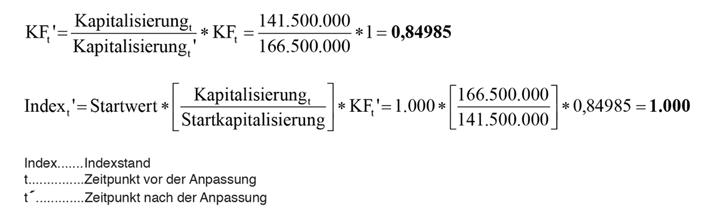
Increase in the number of shares company B:
New number of shares: 11,000,000
| Company | Number of shares | FFF | RF | Price | Index capitalization in EUR |
|---|---|---|---|---|---|
| SHARE A | 10.000.000 | 0.60 | 0.90 | 12.00 | 64,800,000 |
| SHARE B | 11.000.000 | 0.50 | 1.00 | 10.00 | 55,000,000 |
| SHARE C | 7.000.000 | 0.20 | 0.70 | 15.00 | 14,700,000 |
| SHARE D | 8.000.000 | 0.50 | 1.00 | 8.00 | 32,000,000 |
| Total index capitalization | 166,500,000 | ||||
Formula (in German):
What are stock market indices?
Definition
Index types
Types of weighting
Requirements for an index
Index classification criteria
Can I trade an index?