
Stock market prices in newspapers
Austrian daily newspapers feature a special section dedicated to the ATX and ATX Prime, as well as companies listed on the Vienna Stock Exchange. These pages typically present the performance of Austria’s most important stock market indices and most actively traded shares in tabular form, often accompanied by expert commentary. The performance of the ATX is also frequently compared with that of other international stock market indices. This enables investors to gain an initial sense of overall market sentiment on the Vienna Stock Exchange. By comparing their portfolio performance with the index, shareholders can assess whether their investments have outperformed or underperformed the broader market.
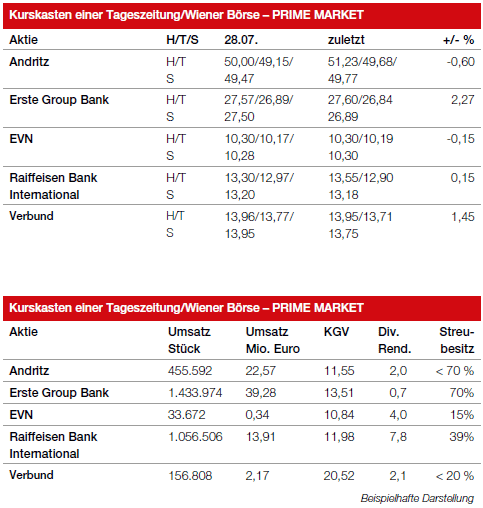
Stock
The name of the listed company.
Market segment
The category in which a security is listed based on specific admission criteria (e.g., market capitalization, liquidity). These requirements vary across different market segments.
High / low / close (H/L/C)
The highest price (high), lowest price (low) and closing price (close) recorded on that day.
Previous high / low / close (previous H/L/C)
The highest, lowest and closing prices recorded on that trading day.
+/- %
Percentage change in the stock’s closing price compared to the previous trading day.
Trading volume (shares)
Number of shares traded on this day.
Trading volume (EUR million)
Total value of shares traded on this day in euros (trading volume = number of shares × closing price).
P/E ratio (price-to-earnings ratio)
The price-to-earnings (P/E) ratio indicates how many times the earnings per share are reflected in the stock price. The lower the P/E ratio, the more affordable the stock generally is.
Dividend yield
The percentage return generated from dividends distributed to shareholders relative to the share price.
Free float
The proportion of a company’s shares that is freely available for trading on the stock market.
Stock market abbreviations
For those new to the stock market, reading the stock price section of newspapers often presents a practical problem. This is because the prices of various stocks are followed by abbreviations. To stock market professionals, these notations convey information that allows for specific conclusions.
Key terms explained:
- eB stands for “ex-subscription right”. This notations indicates that the value of the subscription right has been deducted from the stock’s price.
- eD stands for “ex-dividend.” This price notation indicates that on this day (the so-called ex-dividend date or ex-date), a price adjustment equal to the dividend amount was made.