
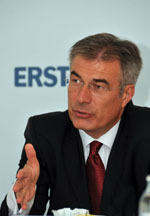
Interview with financial analyst Fritz Mostböck, CEFA
The role of a financial analyst offers a wide variety of interesting and diverse responsibilities. Analysts help market participants navigate the complex world of finance. In the following interview, Fritz Mostböck, CEFA, Head of Group Research at Erste Group Bank AG, provides insights into the profession.
Mr Mostböck, you are Head of Research at Erste Group Bank AG. What are the responsibilities of an analyst? What does the job involve?
Mostböck: The role is extremely varied. Depending on their area of expertise, an analyst's primary task is to assess available or newly received information objectively, put it into context and communicate the findings to the market. Whether focusing on economics or equities, analysts effectively act as a link between information and the market. They evaluate and interpret information, form a clear view and communicate their conclusions to provide guidance for clients, market participants and the public. Overall, it is a very exciting profession.
What does a typical working day look like for you and your colleagues in Research?
Mostböck: Depending on the role, the working day usually starts between 7:30 and 8:30 am. The first task is to gather and review relevant information on the area covered, whether equities or economics, in preparation for the morning conference calls.
Much of the rest of the day is dedicated to analysis and preparing written research reports. However, there are also numerous meetings and discussions, enquiries from clients and journalists, and many presentations to prepare and deliver. The working day can often continue well into the evening.
What qualifications and skills do you need to work as a financial analyst?
Mostböck: Strong analytical skills at both the macroeconomic and microeconomic level are essential. You also need to understand broader economic relationships and strategies, be able to develop your own point of view and communicate it clearly and convincingly, as well as formulate strategies of your own. Teamwork is another important skill for anyone considering a career as a financial analyst.
Are there any specific requirements that applicants should meet?
Mostböck: A university degree in business administration or economics is desirable, as are additional professional qualifications such as CEFA (Certified European Financial Analyst), CIIA (Certified International Investment Analyst) or CFA (Chartered Financial Analyst).
In Austria, for example, the Austrian Association for Financial Analysis and Asset Management (ÖVFA) offers professional training for capital market experts, which also provides the opportunity to obtain the internationally recognised CIIA qualification.
Internships abroad can also be an important step towards a career as a financial analyst.
Thank you very much for the interview!